
From choice to digital sovereignty
Digital sovereignty, in particular, warrants closer examination: what scope for action does open-source code provide? What prerequisites must be met? And how can organisations utilise these opportunities to make autonomous decisions regarding their digital infrastructure?
Freedom of choice as a starting point
Freedom of choice means, first and foremost, being able to choose between different solutions and providers. For digital sovereignty, however, it is equally important to be able to change a decision once it has been made.
A wide choice is of little use if data cannot be transferred, interfaces are lacking, or switching providers involves a disproportionately high level of effort. Digital sovereignty is therefore evident not only in the procurement process, but also in the question of how realistic a subsequent switch is.
Among other things, an organisation acts with sovereignty when it retains control over its data, is free to choose its location and operating model, and can implement its own security requirements. It is equally important that it can use interfaces independently, switch service providers, and have a solution adapted or further developed as required.
This scope for action does not presuppose complete self-sufficiency. Businesses, public authorities and educational institutions remain reliant on technology providers and service providers. The crucial factor is whether they can consciously shape and limit these dependencies.
Verifiability and long-term control
With proprietary software, the source code usually remains under the manufacturer’s control. Users must trust that the software operates as described and processes data in accordance with the agreed specifications.
At the same time, the manufacturer decides how long a solution will be further developed and supplied with security updates. Once it reaches its end of life, organisations are often left with no option but to migrate to a successor product or another platform, even if the existing software continues to meet their requirements.
With open-source software, by contrast, continued development is not, in principle, tied to a single manufacturer. If the source code is available and adequately documented, other providers, communities or the organisation itself can take over maintenance and further development. Whilst this does not guarantee long-term support, it does create additional options for action.
Openness expands scope for action
The ability to continue using software even after a change in strategy or the end of life of a product is a key indicator of digital agency. However, the advantages of open source code are already evident during day-to-day operations: organisations can independently review the software, adapt it to their own requirements and design the operating model flexibly.
Open standards, documented interfaces and exportable data formats also make it easier to switch providers and further develop existing systems. Regular security updates, transparent documentation and the availability of internal or external expertise reinforce these options for action.
Open source thus creates essential technical prerequisites for digital sovereignty. The extent to which this scope for action can be utilised depends on the architecture of the solution as well as on the available operational and support services.
Organising video conferences with confidence
The importance of this issue is particularly evident in video conferencing solutions. They are used for internal coordination, confidential discussions, teaching and public events. In addition to functionality and usability, organisations should therefore also consider where communication and metadata are processed, whether the software’s functionality can be independently verified, and which operating models are available. Equally relevant is whether their own security requirements can be implemented and whether it remains possible to switch service providers at a later date.
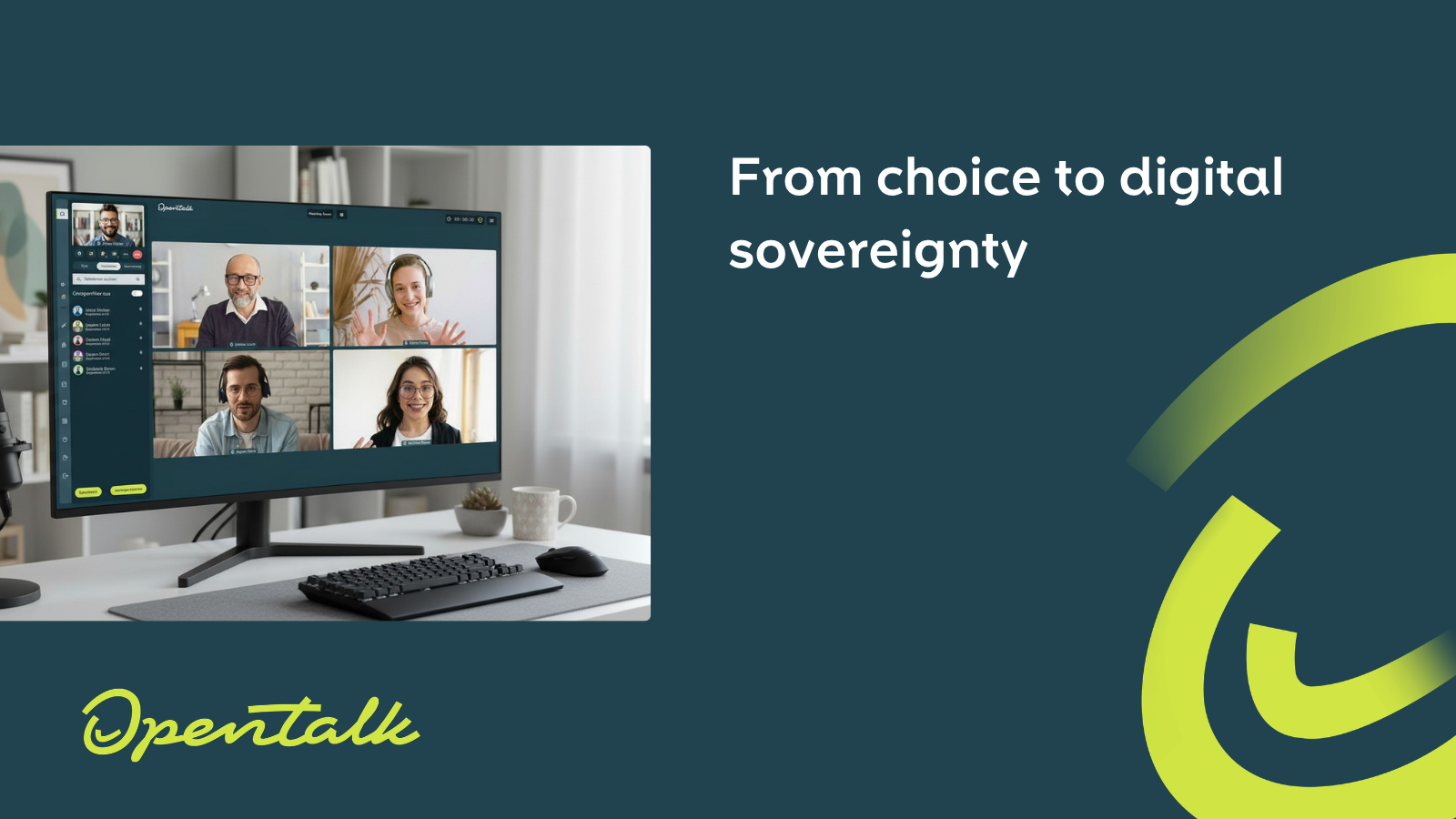
OpenTalk fulfils key prerequisites in this regard. As an open-source solution, the software is verifiable and customisable. Organisations can operate OpenTalk themselves or use it as a hosted service. This allows operation and usage to be adapted to the respective technical, organisational and legal requirements, without committing to a single deployment model from the outset.
From open source to digital sovereignty
Open source creates important prerequisites for shaping digital systems in a self-determined manner: the open source code enables verifiability and control, whilst open standards, technical knowledge and different operating models open up long-term scope for action.
Freedom of choice forms the starting point here. Digital sovereignty arises when organisations can make lasting use of this scope, consciously manage dependencies and change their technological direction as required.
More articles
OpenTalk and ECOS Technology: Partnership for highly secure video conferencing
Video conferencing has become an integral part of everyday working life, including within government departments, public bodies and secur
How sovereign is your video conferencing solution?
Video conferencing is now an integral part of business-critical digital infrastructure.